
Throughout my career, I have noticed significant differences in post-surgical rehabilitation protocols provided by surgeons. Two people with the same surgery, age, and sport may come in with two very different rehab protocols from two different surgeons.
But what about when to start physical therapy following surgery, particularly one of the most common and significant procedures seen by orthopedic and sports physical therapists: ACL reconstruction?
My bias has always been to see patients within a few days of surgery and certainly within the first week in order to restore range of motion and begin strengthening an already weakened quadriceps muscle to improve functional mobility. In other words, the earlier, the better.
Recently, however, we have noticed a trend from some of our referring surgeons delaying the start of PT. I am not exactly sure why, but it may be an attempt to protect the new ACL graft or simply allow pain and swelling to decrease.
Early vs Delayed Physical Therapy After ACL Reconstruction
As I mentioned, I have my biases, but in reality we do not have a large amount of research directly comparing early versus delayed physical therapy following ACL reconstruction. Although I am sticking with what I think is best — let’s get started within a few days after surgery — I wanted to see if any new evidence had emerged.
That’s when I found a study published in 2025, “Impact of Early vs. Delayed Physical Therapy on Functional Recovery, Proprioception, and Return to Sport After Anterior Cruciate Ligament (ACL) Reconstruction.” The researchers compared an early start to PT (within the first 2 weeks after surgery) versus a delayed start (after the first 4 weeks). Patients were followed for up to one year and outcomes included quadriceps strength, proprioception, knee function, range of motion, and return to sport.
What Did the Study Find?
Sure enough, the early PT group demonstrated significantly better quadriceps strength, proprioception, knee function scores, and range of motion. Importantly, these improvements occurred without an increase in graft laxity or signs that the reconstruction was compromised.
What strikes me is that we are talking about only a two week difference in start time, yet the researchers found statistically significant differences months later. Why is this?
Why Might Early Physical Therapy Matter?
My thought is that early rehabilitation helps patients restore normal and more confident movement sooner, regain quadriceps activation earlier, and minimize the rapid muscle atrophy and strength loss that occurs following surgery. The initial effects of disuse on muscle size, strength, and neuromuscular control may be more significant than we realize.
While the study is not perfect — the early PT group was slightly younger and somewhat more active before surgery — it reinforces the idea that early rehabilitation can improve long-term outcomes without increasing risk to the graft.
So, if you are told to wait several weeks, it is worth asking why.
When Should You Start Physical Therapy After ACL Surgery?
That said, I do not think people need to be in PT the day after surgery. Those first few days can be challenging, and the body is already beginning an important healing process. But based on this study, waiting several weeks may not be helpful either.
In my opinion, starting physical therapy within the first week after ACL reconstruction remains a reasonable approach for most patients.
What Happens During Early ACL Rehabilitation?
The PT performed early after ACL reconstruction is not fancy or groundbreaking. We focus on restoring full knee extension, reducing swelling, improving quadriceps activation, and helping patients return to one of the most important functions: walking normally.
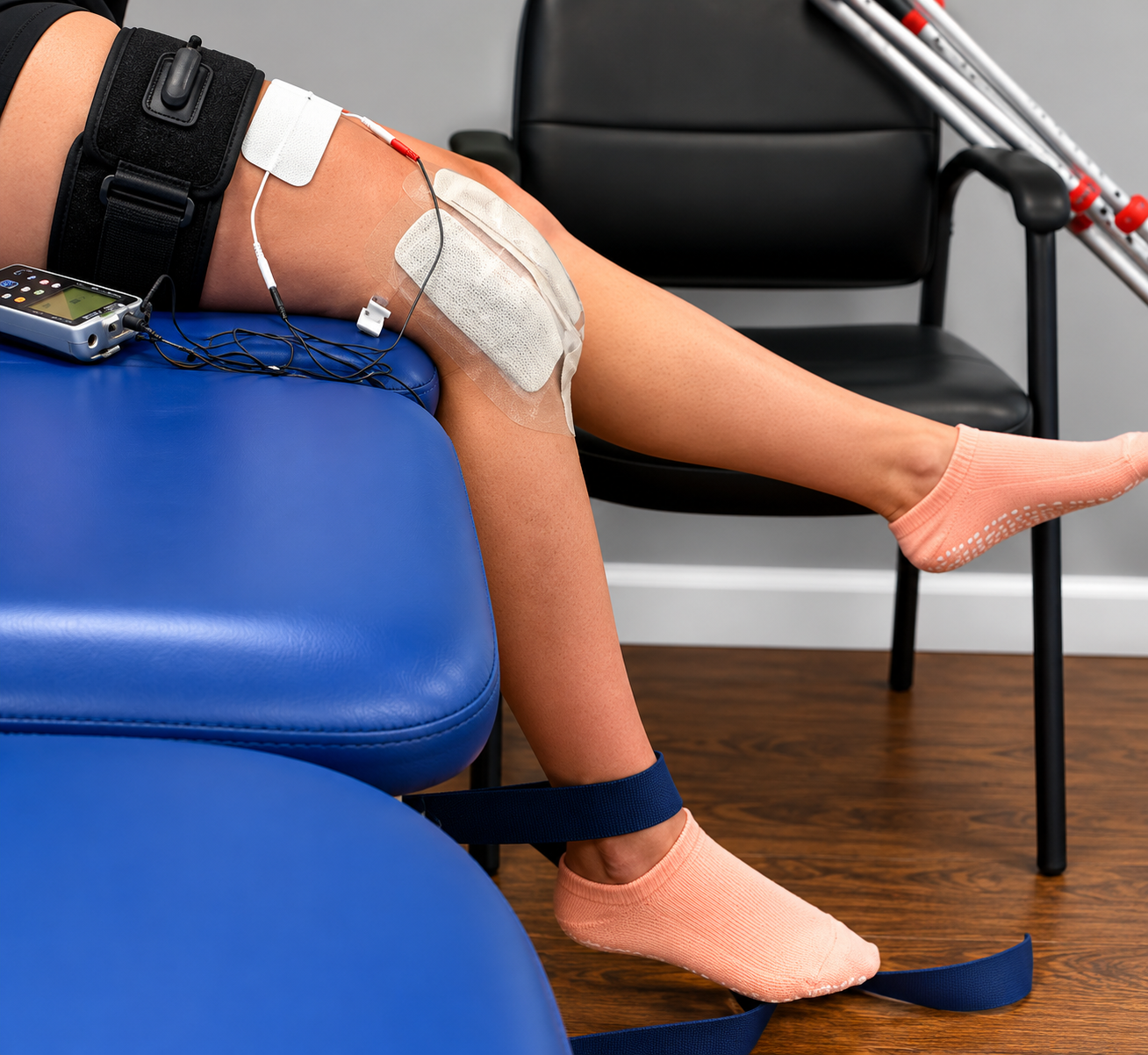
To accomplish this, we use hands-on treatment, neuromuscular electrical stimulation, targeted exercise, blood flow restriction training when appropriate, and education to help patients navigate the early stages of recovery.
Reference
Alqahtani TA, Kardm AA, et al. Impact of Early vs. Delayed Physical Therapy on Functional Recovery, Proprioception, and Return to Sport After Anterior Cruciate Ligament (ACL) Reconstruction: A Cross-Sectional Study. Journal of Orthopaedic Surgery and Research. 2025;20:644.
https://josr-online.biomedcentral.com/articles/10.1186/s13018-025-06054-x
Questions About ACL Reconstruction Rehabilitation?
If you have questions about your rehabilitation after ACL reconstruction or would like to schedule an evaluation, contact Resolve Physical Therapy. We would be happy to help.
John De Noyelles, PT, DPT, OCS, CSCS

John is the owner of Resolve Physical Therapy. He is a board-certified Orthopedic Clinical Specialist and Certified Strength and Conditioning Specialist with more than 15 years of experience treating orthopedic and sports-related injuries. John has particular interests in baseball rehabilitation, sports medicine, running-related injuries, and strength and conditioning. His approach combines evidence-based physical therapy, hands-on care, and progressive exercise to help athletes and active individuals return to sport and stay healthy long term.
